








A ceramic sink starts as a pattern of raw materials and finishes up as a durable, smooth, hard surface that can perform for years of daily use. Firing is one of the most pivotal processes in the manufacturing of sanitaryware products that lies between these two states. The kiln is more than just a heating chamber to ceramic sink manufacturers. It is the arena where chemistry, temperature, timing, moisture and the behaviour of the materials come together to define the nature of the final product.
It begins with a carefully prepared body
To be able to fire ceramic materials, they have to be processed into a consistent body before firing can start. Formulation will affect properties of strength, shrinkage, surface properties and heat response.
Consistency is important as each sink will undergo the same basic transformation.
After a few steps, the resulting product will show certain differences if there are any differences in the starting material.
Geometry is formed by forming
The final shape of the sink is set before it is put into the kiln. Forming techniques are those used to form the bowl, edges, curves, mounting areas, etc.
The material is still somewhat soft and moist here. For this reason, the shape has to be planned and made for the subsequent drying and firing stages.
The shape of the ceramic object will not always be the same before entering the kiln as after firing.
Drying Comes Before Fire
The water in the body must be slowly dried out before firing at high temperatures. If drying is too quick or irregular, it can result in internal stresses that can cause defects.
Controlled drying ensures a more even loss of moisture.
This stage is significant to the ceramic process because it shows that a poorly prepared ceramic will not be fixed in the kiln. It reveals it.
The Heat causes a permanent transformation
The ceramic body will go through several physical and chemical changes within the kiln. As the temperature increases, moisture is expelled, and the material gradually turns into a more robust and stable ceramic material.
Due to the need to control the process, it is necessary to heat the product gradually, evenly and at a suitable speed.
The firing cycle for ceramic sink manufacturers is thus an engineered process that is carefully managed.
Shrinkage is something that needs to be expected
The firing of ceramics usually causes contraction. This requires that the manufacturer take into consideration dimensional changes in the development of their moulds and manufacture of components.
The sizing of the sink may look right before firing, but can end up different after it is fired.
So, it is important to understand shrinkage if you want to keep the dimensional consistency.
Glazing on top of it all
Glaze is applied to many ceramic sinks, which are then fired into the surface. The glaze is also used to give the product a visual appearance while also providing a smooth and easy-to-clean surface.
The behaviour of the glaze through the firing cycle can have an effect on colour, gloss, texture and uniformity of the surface.
So the final surface is created by the preparation of the material and controlled heating.
The Kiln is a controlled environment
In the modern process of ceramic making, it is not enough to attain a high temperature. Final results may be affected by various factors such as temperature distribution, heating rates, holding periods, cooling and atmosphere.
Therefore, the environment of the kiln needs to be carefully controlled in large-scale production.
It is important to achieve consistency between different batches, as it becomes a manufacturing goal.
Cooling is Part of the Process
The change is not complete after the peak temperature is reached. Another factor to consider with cooling is not to let the temperature change too quickly, as this can cause stresses in the ceramic or glaze.
The material can be cooled in a controlled manner, so that it stabilises slowly.
The whole heat-treatment process is, therefore, the determining factor for the final product, not only the hottest moment.
Defects tell a story
Cracks, warping, irregularities, pinholes, glaze defects, or dimensional inaccuracies may serve as clues to various stages of manufacturing.
These defects can be studied by manufacturers to determine the cause, which may be related to material preparation, forming, drying, glazing, firing or handling.
In this respect, quality inspection is a means of interpreting the ceramics’ past.
Technology Makes the Alchemy More Precise
The art of traditional ceramic craftsmanship is now backed by advanced process controls, temperature monitoring, digital measuring, automated equipment, and quality systems.
Manufacturers can now replicate exactly the firing conditions they have developed in a more consistent manner with the aid of technology.
The outcome is not an end to craftsmanship, but an enhancement of that craft skill by increased process control.
From Kiln to Bathroom
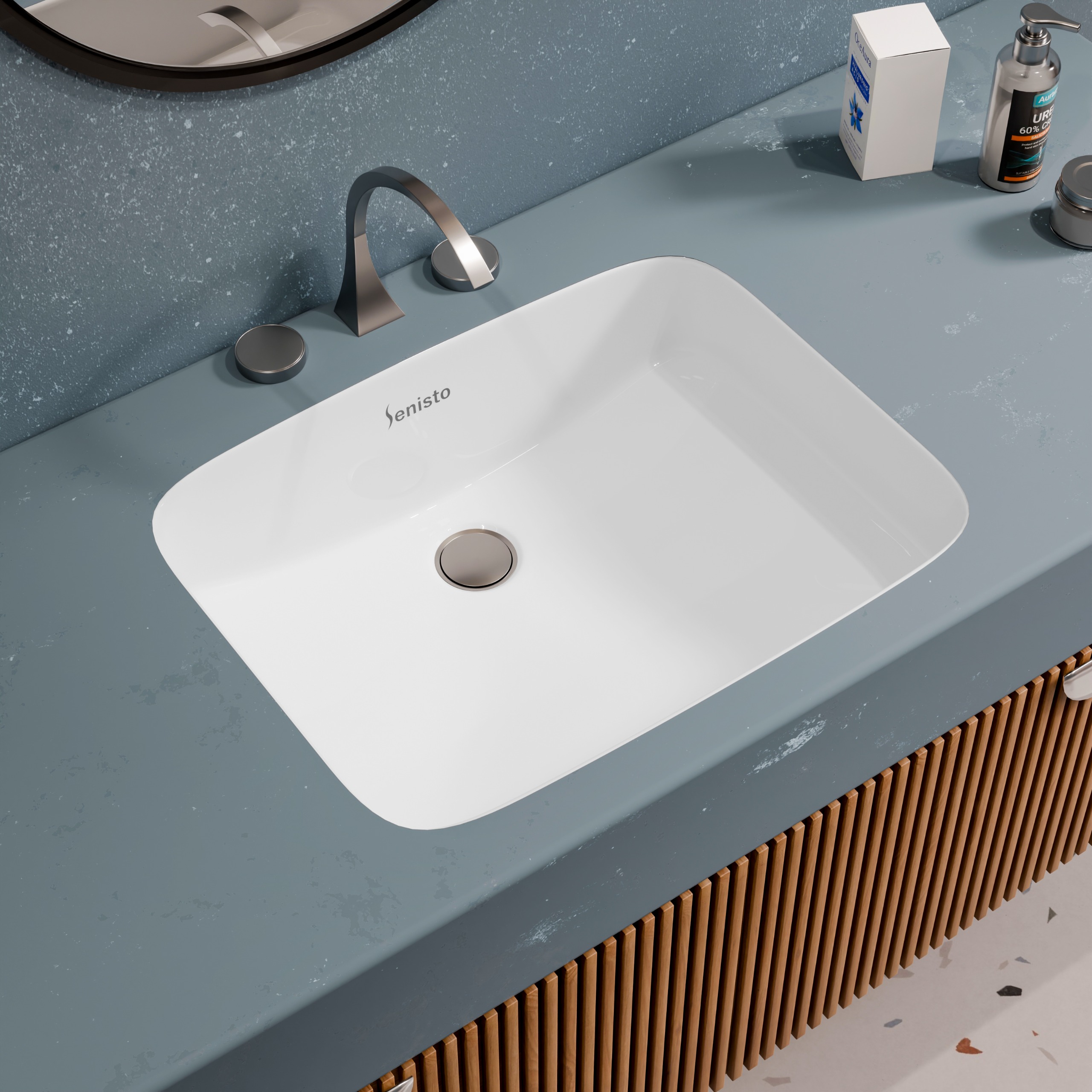
After firing, inspection and finishing, the ceramic sink is ready to be installed in an architectural space.
It has a smooth surface and stable geometry, and may seem simple to use to the user because of its finished form. However, each characteristic has been affected by the regulated transformation that has taken place within the kiln.
The product has the hidden history of its production.
Final Words
The alchemy of the firing process is really the process of controlled transformation in the manufacture of ceramic sinks. The raw material is transformed into a shaped body, moisture is slowly evaporated, the material structure is changed by heat, glaze is applied over the material surface, and it is slowly cooled.
The results are more than fired clay. It’s a by-product of material science, thermal engineering, craftsmanship and careful process control.
The next time a ceramic sink shows up completely smooth and simple, its simplicity can be interpreted differently: a lot of its sophistication was developed well before the sink got to the bathroom.